Built for companies investing $250K+ annually in branded merchandise, uniforms, and print, with transparent pricing, no inventory requirements, and clearer program-level ROI.
Varies
Often marked up to offset product discounts
Minimum Spend Commitment
$250K annually
All branded merchandise, print, and uniforms count toward the total
$50K annually
Fees spike if missed
Credit Card Transaction Fees
None
We absorb standard processing fees
3%—5%
Platform Processing fee
Pick & Pack / Fulfillment Fees
None
No extra handling fees on each order
$2—$5
Per order or per item
Updates & Product Additions
No cost
Add products, update content, and refine the store without extra fees
Billed Hourly
Often billed hourly or per change
Source: iCoStore program data and competitor RFP responses, 2026.
Service First. Not Commission First.
iCoStore account managers are not commissioned.
That means their role is not to sell more products or push more volume. Their role is to support your program, recommend the right solutions, improve the user experience, and make your company store easier to manage over time.
The goal is long-term program success, not product volume.
iCoStore uses an on-demand model, so organizations avoid many of the costs that come with bulk purchasing, warehousing, inventory management, and product obsolescence. Pricing is structured to support flexibility, lower inventory risk, and easier long-term program management.
No. iCoStore programs are built around on-demand production, so items are produced as orders are placed instead of being pre-purchased and stored in bulk.
Every iCoStore program is supported by a dedicated Account Manager who helps with product selection, reporting, store updates, and ongoing optimization. This ensures the program stays aligned with your brand and business needs as it evolves.
Yes. iCoStore programs start at $250K in annual spend across branded merchandise, uniforms, and print. Individual orders have no minimums. The threshold applies to total company-wide program spend, not to any single order.
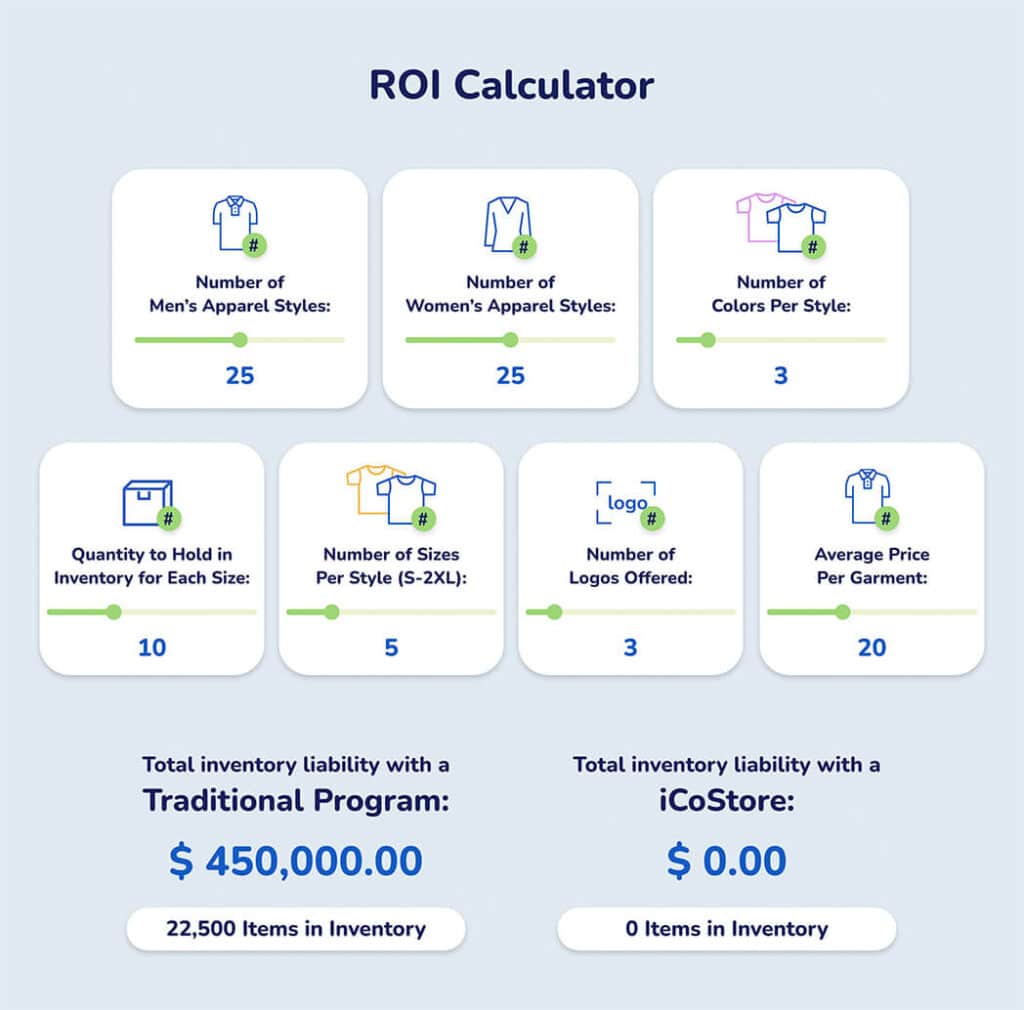
You can use the Apparel Inventory ROI Calculator to estimate what bulk inventory may actually cost when you factor in overbuying, dead stock, and write-offs, then compare that to an on-demand model.